

Services
The Martin Opitz Library offers its users a range of services, which are available either free of charge or for a fee.
These include the provision of scans and photocopies, as well as assistance in areas such as genealogical research.
Below you will find further information on scans and copies, the eBooks on Demand service, and family research.

Scans and Photocopies
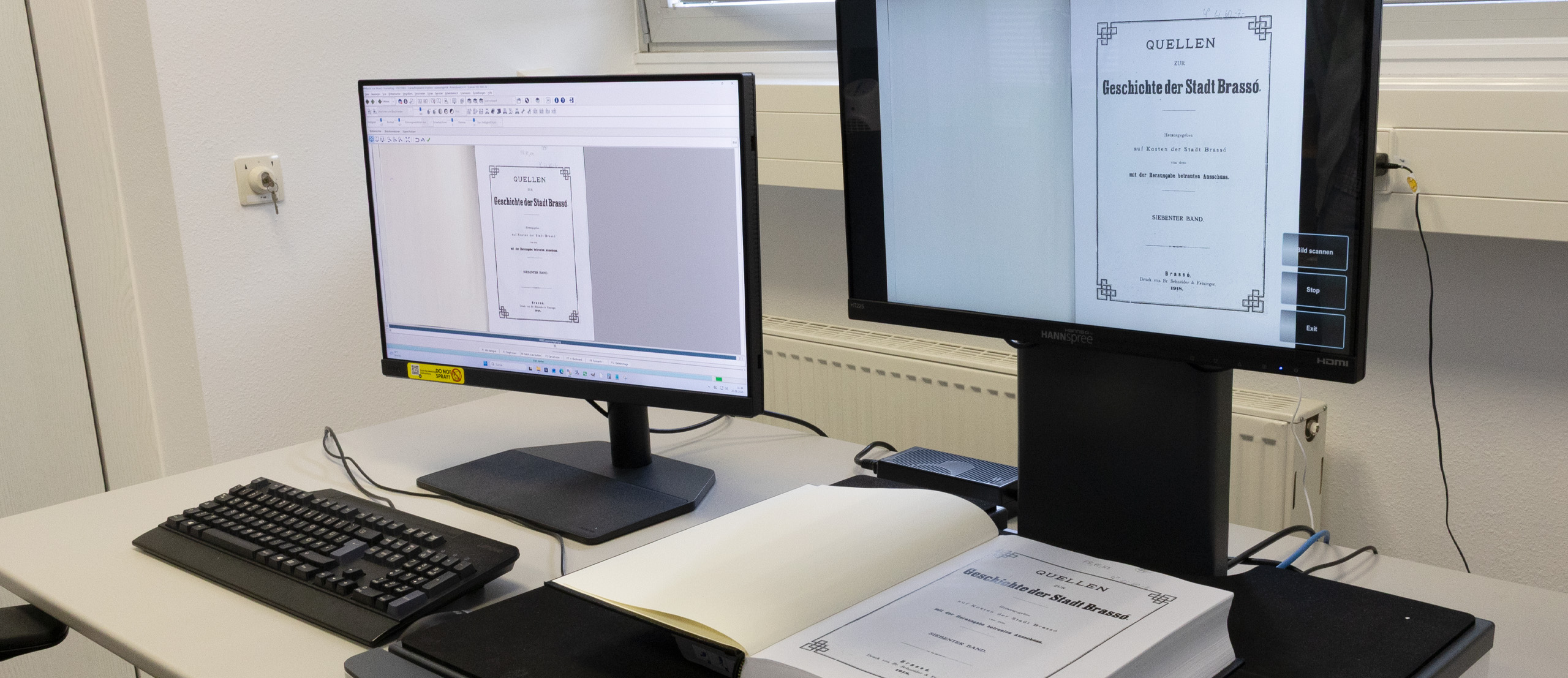
In the premises of the MOB, a microfiche and microfilm scanner, a flatbed scanner and a photocopier are available for use either free of charge or for a small fee.
Upon request, MOB staff can produce copies up to DIN A3 for a fee. Colour copies are also available up to DIN A3. Digital copies – i.e. copies without printing – can be made up to DIN A1.
Upon request, scan results can also be provided on a data carrier for an additional fee.
eBooks on Demand
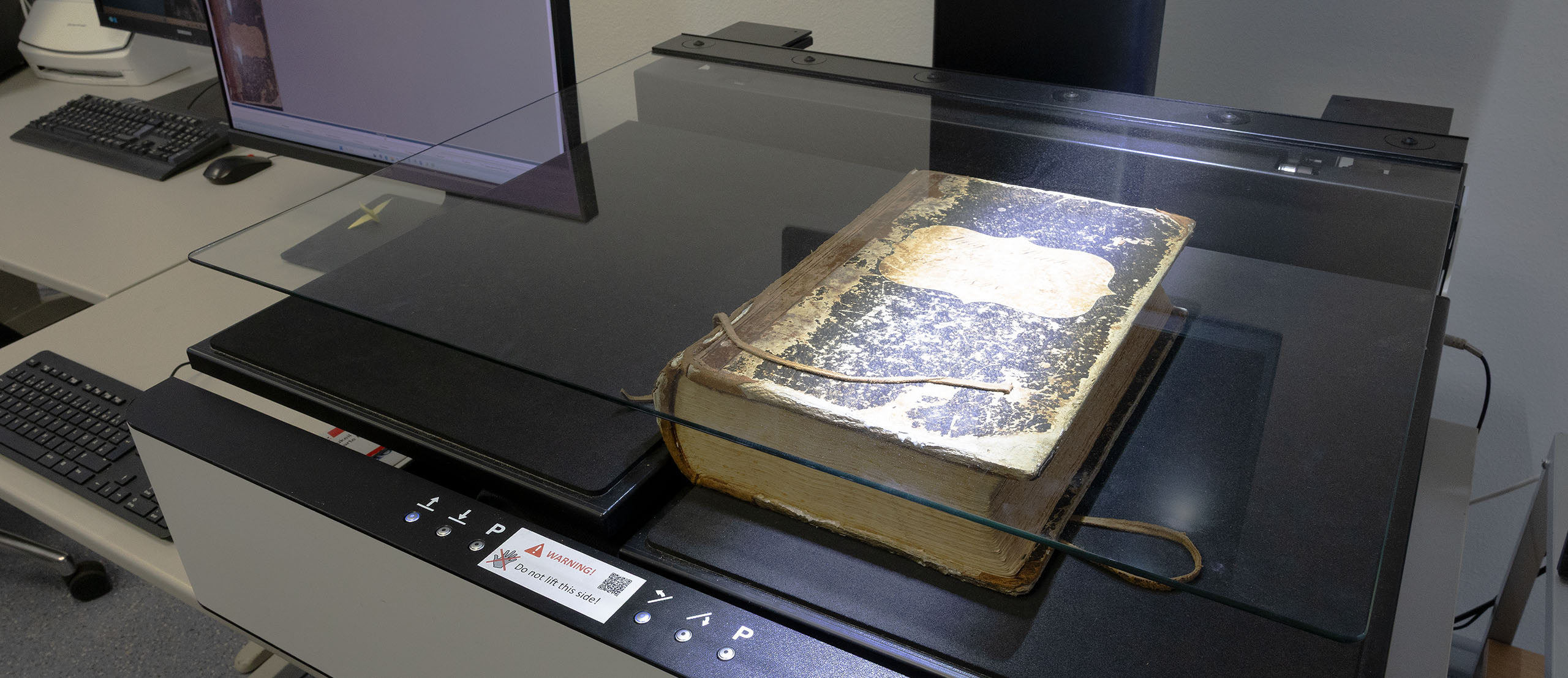
Since 2012, we have been offering the option of digitising monographs and multi-volume works from the MOB's historical holdings, published up to and including 1900.
As part of the document delivery service eBooks on Demand, you can conveniently order the book you require from home as an eBook with full-text recognition, including recognition of Fraktur typefaces.
Within a maximum of 14 days, you will receive a facsimile in PDF format via the internet. Optionally, an RTF file can also be provided, which can be edited using a word-processing programme.
The benefits of eBooks on Demand at a glance:
- Easy ordering via the internet
- Receive a high-quality digital reproduction directly on your screen
- View individual pages and print them as needed
- Search the text for any keyword or search term
Ordering
In the MOB Online Catalogue, you will find an EOD button in the catalogue record of every book that can be digitised. Clicking this button opens an order form containing the details of the selected book and displaying the total digitisation cost.
You only need to register; an MOB library card is not required. You can then submit your order to the MOB and, within two weeks at the latest, you will receive a link from which you can download the digital copy.
Prices
The digitisation fee consists of a basic charge of €10 and a per-page charge of €0.16.
The total cost is calculated automatically and displayed in the order form.
Optionally, you can have the digital copy sent to you by post on a data carrier (CD/DVD).
The additional charge for material and shipping costs is €12.
You can also request a printout/reprint (POD). The additional charge is €6 basic fee plus €0.04 per page plus €10 shipping costs to all European countries (except Austria, where shipping is free).
Contact
If you have any questions about eBooks on Demand at the MOB, please contact:
Arkadiusz Danszczyk
Email: arkadiusz.danszczyk@herne.de
Telephone: +49 (0)2323 16 21 88

Further information about the European library network and the digitisation of books can be found at the following website:
Genealogical Research
The Martin Opitz Library holds one of the most comprehensive collections for genealogical research. Also known as family history or genealogy, genealogical research focuses on tracing family relationships and developments while also taking into account the social and historical circumstances that have shaped them. In some cases, research may also extend to more distant relatives in order to provide a more complete picture.
Sources used for this type of research include civil and population registers, as well as biographical sources such as oral history interviews. Written autobiographical records may also provide valuable information.
In addition to general reference works and research tools, the Martin Opitz Library holds a wide range of materials specifically relating to genealogy in the former German territories and settlement areas of Eastern Europe. Our online catalogues allow you to check which publications and other materials are held in our collections and whether the sources you are looking for are available. Please note, however, that our collections cannot be searched comprehensively by the name of a private individual across all holdings.
Unfortunately, we are unable to conduct research into individual family histories or provide information about specific persons. Reconstructing an individual's life and family history generally requires extensive research in a variety of archives and libraries. The information gathered from these different sources must then be pieced together to form a complete picture. The archives and libraries that need to be consulted will therefore vary depending on the individual case.
You can access our collections at the following websites:
- Library collections (WebOPAC) mob.bsz-bw.de
- Archival collections kat.martin-opitz-bibliothek.de/vufind/
- Digital Collection digital.martin-opitz-bibliothek.de
If you have specific questions about materials in our collections, you are welcome to consult them in person, borrow them or, where possible, request copies.
The following online resources may also be helpful for your genealogical research:
- Association for Computer Genealogy compgen.de
- Working Group of East German Genealogists agoff.de
- Archives in Poland www.szukajwarchiwach.gov.pl
- Genealogists in Poland metryki.genealodzy.pl
The Foundation Flight, Expulsion, Reconciliation also provides a useful guide to genealogical research on its website, which can be downloaded
here: sfvv.e-fork.net
Guest and Research Visits
We are pleased to welcome visiting researchers to the Martin Opitz Library. We provide a quiet and comfortable environment for your research and are happy to assist you wherever possible.
To help you make the most of your time at the library, please contact us in advance at information.mob@herne.de to arrange your visit.
If you already know which materials you would like to consult, we recommend sending us your requests for books, archival materials and other resources about one week before your visit. This will give us time to prepare the materials for you and ensure that you can make the most of your research time at the library.
You can search our catalogues here. Our digital collections are available online, and our archival database can be accessed here.