

Mission Statement
The Martin Opitz Library is Germany’s central academic special library dedicated to the history and culture of Germans in Eastern Europe. It is also an affiliated institute of Ruhr University Bochum.
We combine historical collections with modern information services and provide an open space for research, education and social dialogue.
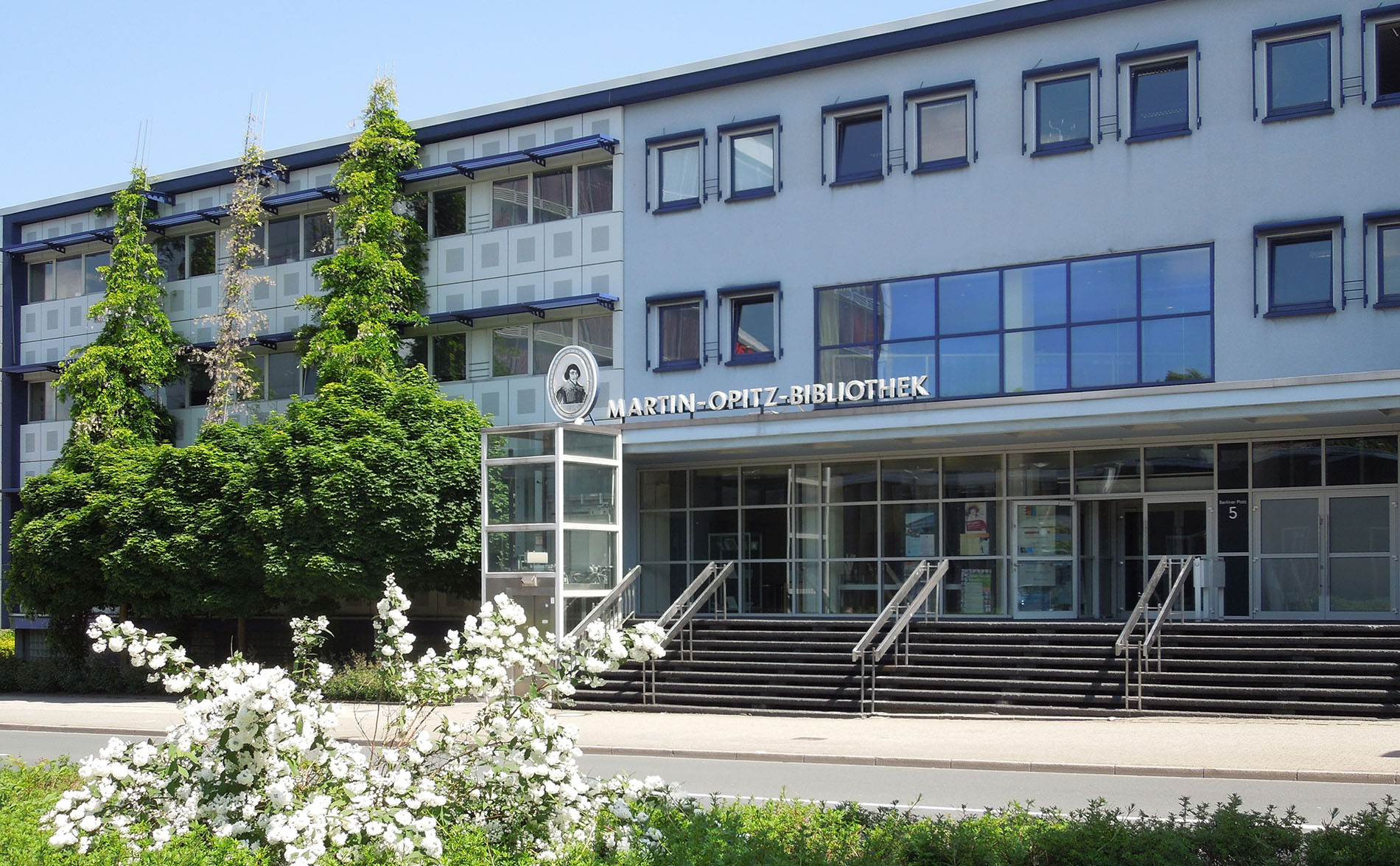
Knowledge that Builds Bridges
The Martin Opitz Library Foundation is Germany’s central academic special library dedicated to the history and culture of Germans in Eastern Europe. It is also an affiliated institute of Ruhr University Bochum.
We collect, preserve and catalogue written and visual German cultural heritage from Eastern Europe and make it permanently accessible for research, education and society. We believe that knowledge builds bridges: between countries and cultures, between the past and the future, and between academia and society."
Intercultural Dialogue and New Perspectives
As a vibrant place of knowledge, we promote academic exchange, intercultural dialogue and new perspectives on European history.
Through both analogue and digital services, we provide access to historical sources, literature and archival materials. In doing so, we encourage a differentiated engagement with the past, German culture of remembrance and the interconnected histories of Europe.
Research, Cooperation / Partnerships, Cultural Outreach
The Martin Opitz Library Foundation was established in 1989 by the City of Herne and the State of North Rhine-Westphalia, building on the collections of the Library of the German East. Today, it is supported by the Federal Republic of Germany, the City of Herne, the State of North Rhine-Westphalia and the Regional Association of Westphalia-Lippe.
Our work is based on the statutory cultural mandate set out in Section 96 of the Federal Expellees Act (BVFG). This legislation requires the federal and state governments to safeguard the cultural heritage of the areas from which Germans were expelled, to make it accessible through scholarly research, and to promote research and cultural outreach.
We fulfil this mandate as a repository of knowledge, a place for exchange and a platform for international cooperation – open, academically grounded and future-oriented.
Cooperation
The Martin Opitz Library works with a range of partner institutions on the culture and history of Germans in Eastern Europe. These institutions are likewise involved in research and activities relating to German culture in Eastern Europe. Their work is briefly presented below.
In 1989, the Martin Opitz Library Foundation was established by the City of Herne and the State of North Rhine-Westphalia, building on the collections of the Library of the German East (Bücherei des Deutschen Ostens).
Today, the Foundation is supported by the Federal Republic of Germany, the City of Herne, the State of North Rhine-Westphalia and the Regional Association of Westphalia-Lippe. The foundation for our work is the statutory cultural mandate set out in Section 96 of the Federal Expellees Act (Bundesvertriebenengesetz, BVFG).
This legislation obliges the Federal Government and the federal states to safeguard the cultural heritage of the areas from which Germans were expelled, to make it accessible through scholarly research, and to promote research and cultural outreach. We fulfil this mandate as a repository of knowledge, a place for exchange and international cooperation – open, academically grounded and future-oriented. In order to fulfil these responsibilities, the Martin Opitz Library has maintained numerous national and international partnerships for many years with schools, universities and other academic and non-academic research institutions. These partnerships are continuously expanded and nurtured.
You can view an overview of our cooperation partners here.
Sustainability
The Martin Opitz Library strives to act and operate sustainably in all areas:
Environmentally friendly, economically sound and socially responsible.

Sustainable Development Goals
In 2015, the United Nations General Assembly adopted the „Agenda 2030“, with its 17 “Sustainable Development Goals” (SDGs), to which the Martin Opitz Library is committed.
Accordingly, through its core activities and with its own resources, the Martin Opitz Library places particular emphasis on the SDGs Quality Education, Peace, Justice and Strong Institutions, and Industry, Innovation and Infrastructure. In addition, the Martin Opitz Library takes into account measures relating to Climate Action, Affordable and Clean Energy, Responsible Consumption and Production, and Decent Work and Economic Growth in its operations. Partnerships for the Goals represent another SDG that provides important guidance for the Martin Opitz Library.
Projects, Knowledge and Networking
The Library management and staff have undertaken further training on sustainability-related topics, including transformation management and Green IT. A range of key performance indicators for the Martin Opitz Library has been determined, and a carbon footprint has been prepared using the CO₂ Culture Calculator.
In cooperation with the Rathgen Research Laboratory of the National Museums in Berlin, temperature and humidity levels throughout the main building are systematically recorded and evaluated on an hourly basis.
These findings form the basis for efforts to reduce resource consumption, particularly electricity, heating and materials, while taking into account the Library’s mission as well as conservation and financial considerations.
Maintaining contact with the City of Herne administration is essential for the Martin Opitz Library. Exchange and networking with other cultural institutions are also important, including the Green Culture contact point and the Green Library Network.


The Martin Opitz Library is currently participating in the ÖKOPROFIT® project https://www.wirtschaftsfoerderung-dortmund.de.
Martin Opitz Library Measures – Energy and Materials
The building structure, utilities, lighting and mobility, including business travel, have been and continue to be gradually optimised at the Martin Opitz Library. Initially prompted by the energy crisis, significant reductions in consumption have already been achieved in recent years, resulting in lower CO₂ emissions. For example, the heating control system was reviewed and inefficient lighting was replaced with LED technology.
Structural measures from 2026 onwards will improve the building’s airtightness and the climate-related division of interior spaces. Staff members also contribute to reducing consumption through thoughtful and responsible action. The Library welcomes the integration of employees’ expertise and ideas through a bottom-up approach.
One of the Martin Opitz Library’s priorities is the installation of a photovoltaic system. The roof of the building offers ideal conditions for such an installation, and preparations for the project are currently under way.
The Library procures and uses a wide range of materials. Products and suppliers are also assessed with regard to energy efficiency and social and environmental standards. Short transport routes are likewise desirable.
The aim is to use resources carefully and according to actual needs, while promoting reuse and proper disposal.
Catering at events takes Fairtrade and vegan products into consideration.
Sustainability and Information Technology
The choice of equipment, as well as the location and scale of data storage, has an impact on resource and energy consumption. Consequently, sustainability considerations in the development of IT infrastructure form an important part of the Library’s strategy.
Energy efficiency, durability and the repairability of technical equipment are important criteria in procurement.
Collection-Related Sustainability
The Martin Opitz Library is a member of the
Working Group on Historical Collections and the
Emergency Network for the Central Ruhr Region
This provides opportunities for regular exchange with other institutions on the preservation of collections. Practical emergency exercises are also organised jointly.
Our Mission
We collect, preserve and communicate the written cultural heritage of Germans in Eastern Europe and ensure its permanent accessibility for research, education and the public.
Our Vision
We aim to be the leading point of reference for knowledge about the German history and culture of Eastern Europe – open, connected and digitally accessible to people worldwide.
Our Values
- Long-term preservation of German cultural heritage
- Openness and accessibility for everyone interested
- European cooperation with partner institutions
- Innovative access to our media and the digitisation of our collections
- Excellence in our library and academic work